 11
11
Investing in the stock market used to feel like an exclusive club. With shares of companies like Berkshire Hathaway trading at tens of thousands of dollars each, many everyday investors felt locked out. But fractional shares have changed the game entirely — making it possible to own a slice of virtually any publicly traded company for as little as $1.
In this complete beginner’s guide, you’ll learn exactly what fractional shares are, how they work, their key benefits and risks, and how to start investing in them today.
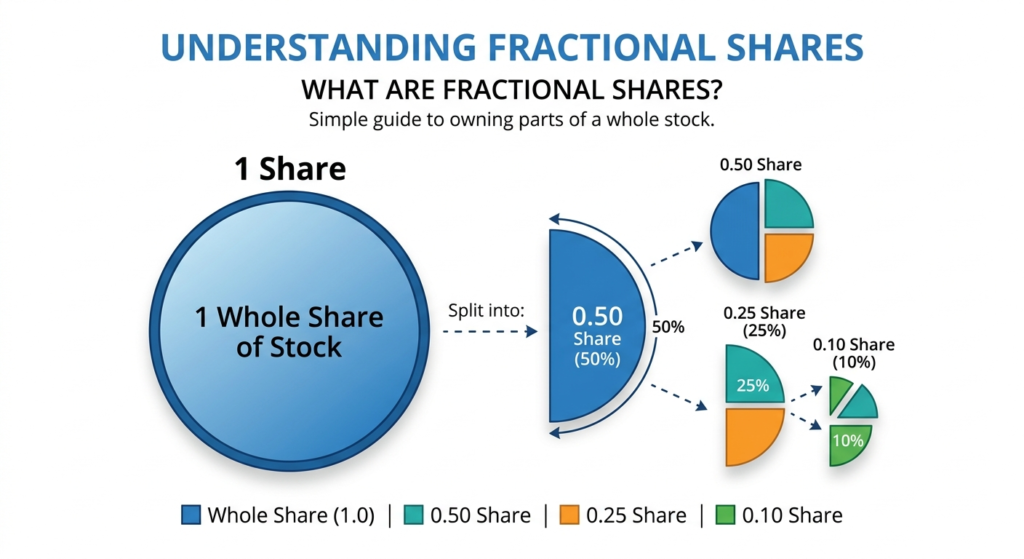
A fractional share is a portion of a single full share of stock. Instead of buying one complete share of a company, you purchase a fraction — say, 0.1 or 0.5 of a share.
For example, if a share of Apple (AAPL) costs $200 and you only have $50 to invest, you could buy 0.25 of a share. You still own a real piece of Apple — just a smaller slice of the pie.
Fractional shares work just like full shares in most respects: they rise and fall in value as the stock price moves, and they may even earn you proportional dividends.
Fractional shares aren’t entirely new. They’ve existed for decades in contexts like:
However, fractional shares as a deliberate investment product became widely available only in the last decade, largely driven by the rise of commission-free trading apps like Robinhood, Fidelity, and Charles Schwab. Today, buying fractional shares is straightforward, intentional, and accessible to anyone.

When you buy a fractional share through a brokerage, the mechanics depend on the platform:
Most major brokerages purchase whole shares on your behalf and then allocate fractions proportionally to customers. For example, if 10 investors each want $10 worth of a $100 stock, the broker buys one full share and distributes 0.1 shares to each investor.
Many modern platforms let you invest by dollar amount rather than share quantity. You simply type in how much money you want to invest — say, $25 — and the platform calculates the corresponding fraction and executes the trade.
When you own fractional shares, you generally:
Fractional shares offer a range of powerful advantages, especially for beginner investors.
The most obvious benefit is accessibility. You no longer need hundreds or thousands of dollars to invest in high-priced stocks. With fractional shares, you can start building a portfolio with as little as $1 or $5.
Diversification — spreading your money across multiple investments — is one of the most important principles in investing. Without fractional shares, a small budget might only stretch to a handful of stocks. With fractional shares, you can spread $100 across dozens of different companies and sectors, reducing your overall risk.
Blue-chip companies like Amazon, Tesla, Nvidia, and Alphabet (Google) often carry high share prices. Fractional shares remove the price barrier, letting you invest in companies you believe in regardless of their share price.
Dollar-cost averaging (DCA) is the strategy of investing a fixed amount at regular intervals, regardless of market conditions. Fractional shares make this easier because you can invest a consistent dollar amount (e.g., $50 every month) without worrying about whether it perfectly divides into whole shares.
Without fractional shares, uninvested cash often sits idle in your account because it’s not enough to buy a full share. Fractional investing puts every dollar to work immediately.

While fractional shares are a powerful tool, they come with some caveats every investor should understand.
Not every broker offers fractional shares, and even those that do may restrict the feature to certain stocks or ETFs. Always confirm your platform supports fractional investing before planning around it.
Fractional shares can sometimes be harder to sell quickly, especially during volatile markets. Since brokers aggregate fractional positions internally, there may be slight delays compared to trading full shares on the open market.
One often-overlooked limitation: you generally cannot transfer fractional shares between brokerages. If you decide to move your investments to a new platform, you may be forced to sell your fractional positions first — potentially triggering a taxable event.
As mentioned, many brokers do not pass through shareholder voting rights for fractional holdings. If owning a voice in corporate governance matters to you, check your broker’s policy carefully.
The ease and low cost of buying fractional shares can tempt beginners into overtrading — buying and selling frequently in response to short-term market movements. This erodes returns over time. A disciplined, long-term approach is always recommended.
| Feature | Full Shares | Fractional Shares |
|---|---|---|
| Minimum investment | Full share price | As low as $1 |
| Dividends | Yes | Yes (proportional) |
| Voting rights | Yes | Sometimes |
| Transfer between brokers | Yes | Usually must sell first |
| Availability | All brokers | Select brokers/stocks |
| Liquidity | High | Slightly lower |
Fractional shares are particularly well-suited for:
That said, even experienced investors use fractional shares to fully deploy their capital and fine-tune portfolio allocations with precision.
Getting started with fractional shares is simpler than you might think.
Step 1: Choose a Brokerage That Offers Fractional Shares Look for platforms that explicitly support fractional investing. Popular options include Fidelity, Charles Schwab, Robinhood, and Interactive Brokers. Compare their fees, available stocks, and user experience.
Step 2: Open and Fund Your Account Complete the account registration process. Most brokers allow you to fund your account via bank transfer. There’s often no minimum deposit required.
Step 3: Research Your Investments Before buying, research the companies you’re interested in. Look at their financial health, growth prospects, and how they fit into your overall investment strategy.
Step 4: Place a Dollar-Based Order Navigate to the stock you want to buy and select the option to invest by dollar amount. Enter how much you want to invest (e.g., $25), review the fractional share amount you’ll receive, and confirm the trade.
Step 5: Monitor and Stay Consistent Review your portfolio periodically, but resist the urge to react to every market swing. Set up recurring investments if possible to automate your dollar-cost averaging strategy.
From a tax perspective, fractional shares are treated the same as whole shares:
Always consult a qualified tax professional for advice specific to your situation.
Can I lose money with fractional shares? Yes. Fractional shares carry the same market risk as full shares. If the stock price falls, your investment loses value proportionally.
Do fractional shares pay dividends? Yes — if the company pays dividends and your broker supports dividend pass-through, you’ll receive a proportional dividend on your fractional holding.
Are fractional shares good for long-term investing? Absolutely. Many financial experts consider fractional shares one of the best tools for long-term, disciplined investing — especially when combined with a dollar-cost averaging strategy.
What happens to my fractional shares if my broker goes bankrupt? In most countries, brokerage assets are protected by regulatory bodies (e.g., SIPC in the United States) up to certain limits. However, fractional shares held in pooled accounts may face additional complexity. It’s worth reading your broker’s terms carefully.
Fractional shares have democratized investing in a meaningful way. They’ve torn down the price barriers that once kept everyday investors out of premium stocks, made true diversification achievable on any budget, and enabled consistent investing habits through dollar-cost averaging.
Whether you have $10 or $10,000 to invest, fractional shares give you the flexibility to put your money to work exactly where you want it — one fraction at a time.
The best time to start investing was yesterday. The second best time is today.
Disclaimer: This article is for informational and educational purposes only and does not constitute financial advice. Always conduct your own research and consult a qualified financial advisor before making investment decisions.