 11
11
Investing is no longer limited to people with large amounts of money. Thanks to fractional shares, you can start investing with as little as a few dollars. But many beginners still ask a key question: how do fractional shares actually work?
This guide breaks it down step by step—clearly, practically, and without unnecessary complexity—so you can understand exactly how fractional investing functions in real-world scenarios.
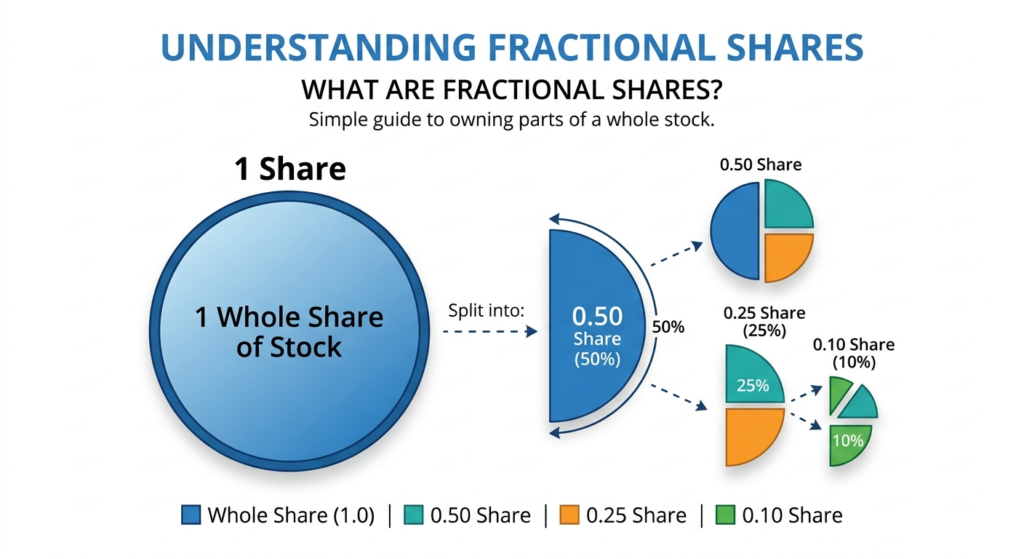
Fractional shares represent a portion of a single stock, rather than a whole share. Instead of buying 1 full share, you can buy a fraction like 0.5, 0.1, or even smaller.
For example, if a stock costs $1,000 per share and you invest $100, you’ll own 0.1 of that share.
This makes it possible to invest in expensive companies like Apple Inc. or Alphabet Inc. without needing the full share price.
Let’s walk through the exact process from start to finish.
First, you need an investment platform that allows fractional investing. Not all brokers offer this feature, but many modern platforms do.
Popular platforms include:
These platforms are designed to make investing accessible, even for beginners.
Once your account is set up, you deposit money—this can be any amount depending on the platform.
For example:
There’s no requirement to match the price of a full share.
Next, you choose a company you want to invest in. This could be a large-cap company or a growing startup listed on stock exchanges.
Many investors prefer companies included in indices like the NASDAQ Composite or S&P 500 because they represent established businesses.
This is where fractional shares differ from traditional investing.
Instead of saying:
“I want to buy 1 share”
You say:
“I want to invest $100”
The platform automatically calculates how much of the share you’ll receive.
Once you confirm your purchase:
Behind the scenes, the brokerage may either:

After purchase, your fractional shares appear in your portfolio just like full shares.
You’ll see:
Your investment behaves exactly like a full share—just scaled down.
Fractional shares move in value proportionally to the stock price.
Example:
If the stock drops, your value decreases accordingly.
There’s no difference in percentage returns between fractional and full shares.
If the company pays dividends, you’ll receive a proportional amount based on your fractional ownership.
Example:
Many platforms allow automatic dividend reinvestment, meaning your earnings buy more fractional shares.
Selling works just like buying:
However, some platforms may have minor delays or restrictions compared to full shares.
Let’s say you have $300 to invest.
Instead of buying one stock, you decide to diversify:
Even if each stock costs more than $300 per share, fractional shares allow you to split your investment across multiple sectors.
Fractional shares don’t exist directly on stock exchanges in the same way full shares do. Instead, brokers manage them internally.
They typically use one of these methods:
The broker buys full shares and divides them among users.
Multiple small orders are combined into one large trade.
The broker uses its own stock inventory to fulfill fractional orders.
This is why fractional shares are often tied to the platform you use.
You can start investing with very little money.
Spread your investment across multiple stocks instead of relying on one.
Invest in premium companies without needing thousands of dollars.
Invest fixed amounts regularly to reduce market timing risk.
You may not be able to transfer fractional shares to another broker.
Voting rights may be limited depending on the platform.
Selling fractional shares can sometimes take longer.
Fractional shares make investing easier—but not safer. Always research the company.
Spreading too thin across many stocks can reduce meaningful returns.
Avoid investing based only on hype or social media trends.
Yes—fractional shares are one of the best entry points into investing.
They allow you to:
Fractional shares have fundamentally simplified investing. Instead of worrying about share prices, you can focus on how much you want to invest and where.
The step-by-step process is straightforward:
This flexibility makes fractional shares a powerful tool—especially for beginners aiming to build long-term wealth.